Adrift Under the Korean Flag
For months on end without touching land, thousands of Indonesian crew keep South Korea’s distant-water fishing fleet running — on rationed water, boundless work, and almost no way to file a complaint. Their testimony finds corroboration in government documents and satellite records.
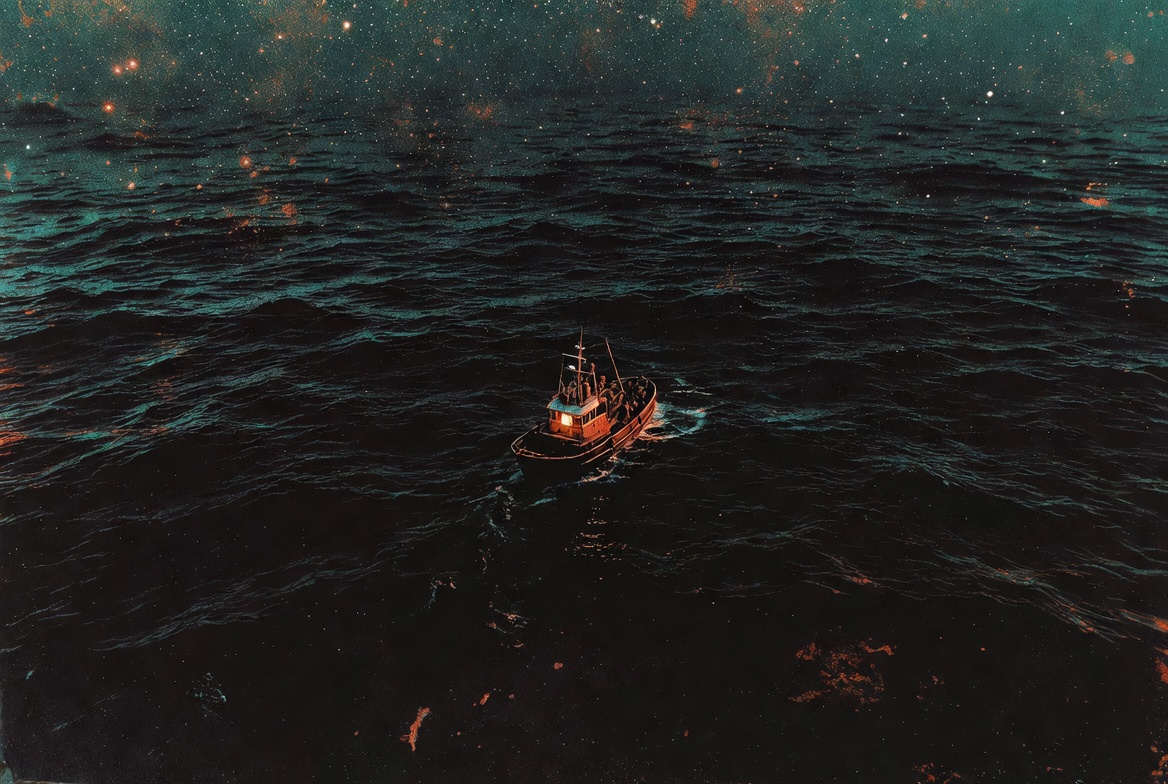
The Pacific Ocean, nearly a thousand kilometers from the nearest land.
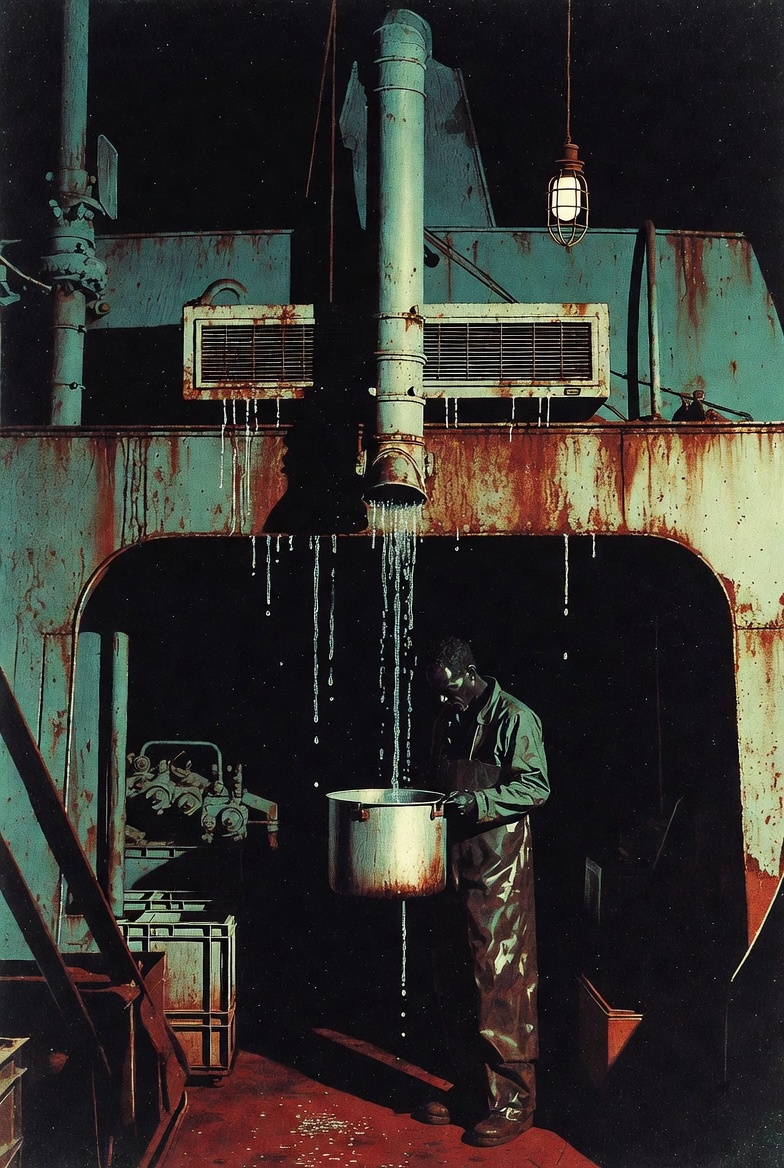
On the deck of a South Korean–flagged longliner, a man from West Java catches water dripping from the drain pipe of an air-conditioning unit.
He collects it, boils it, then drinks it.
Not for a day or two. For months.
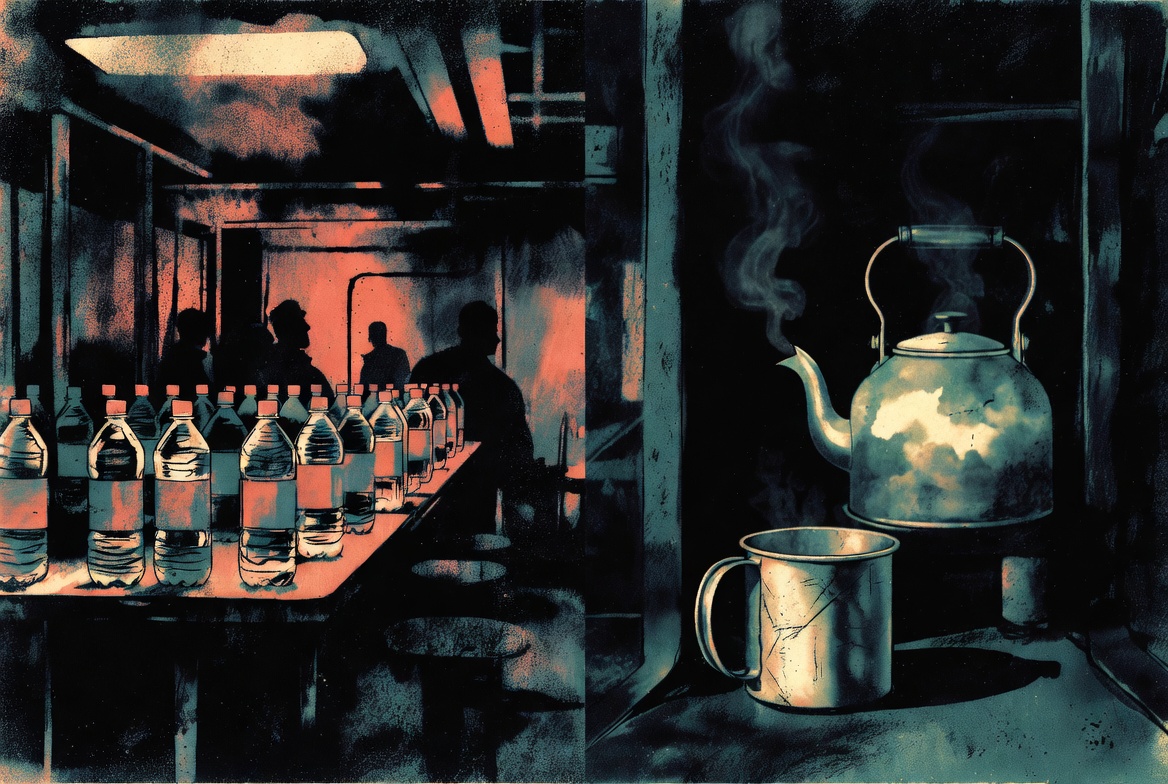
On the same ship, in the officers’ mess, rows of bottled water are lined up.
Those bottles are not for him.
“Bottled mineral water like this, brought from shore — that’s only for the Koreans.”
The man — call him Bowo — came home at the end of 2025 from his third Korean ship. He is one of 3,469 Indonesian crew who, according to South Korea’s own official figures, work aboard the country’s distant-water fishing fleet. That fleet supplies tuna, squid, and premium fish to markets in Japan, the United States, and Europe. Eight of every ten of its foreign crew are Indonesian.
For more than a decade, Indonesian public anger over the exploitation of crew on the high seas has pointed almost always at two flags: China and Taiwan. There were bodies buried at sea. There were wages that never arrived.
South Korean–flagged ships come up far less often. Yet the crews’ accounts reveal a pattern not so different: boundless working hours, drinking water and facilities allotted by nationality, documents withheld, and a complaint channel under the captain’s control.
This story sets three layers of evidence side by side: the testimony of crew freshly off the ships; South Korean government documents showing the problem has long been known; and more than 130,000 satellite event records from Global Fishing Watch that help trace the ships, their fishing grounds, their meetings at sea, and their destination ports.
Testimony can be dismissed as one-sided. Documents and vessel tracks make that dismissal harder.
Fourteen days of clean water for fourteen months
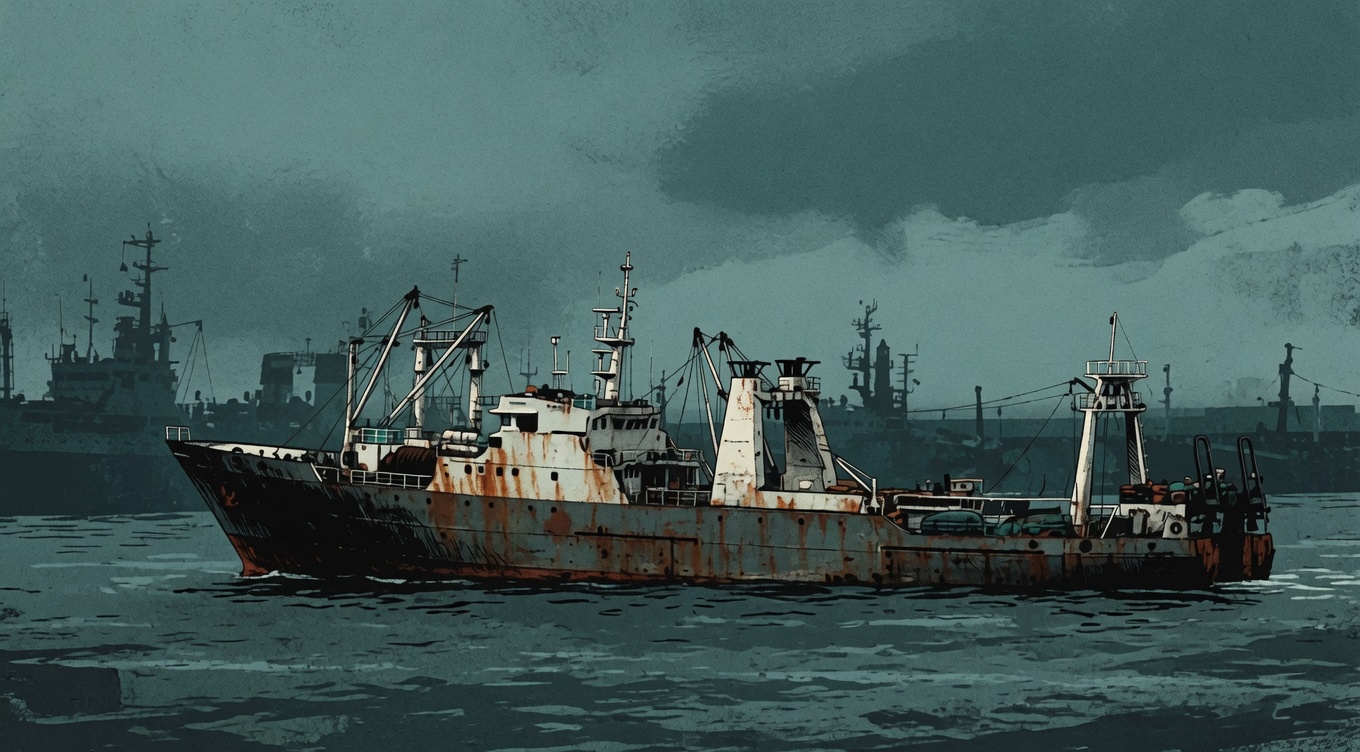
October 2024. Bowo boards the Oryong 306 in Busan. Follow the line: from the port of Busan, the ship sails two weeks into the mid-Pacific — and stays there.
Each yellow dot is a meeting between the Oryong 306 and another vessel in the open ocean recorded by satellite through 2021–2025: bunker ships topping up fuel, reefers collecting tuna, fellow Oryong vessels swapping supplies. All the while the ship need not — and its crew could not — return to port.
Click a dot for its date & details
Fourteen Days of Clean Water for Fourteen Months
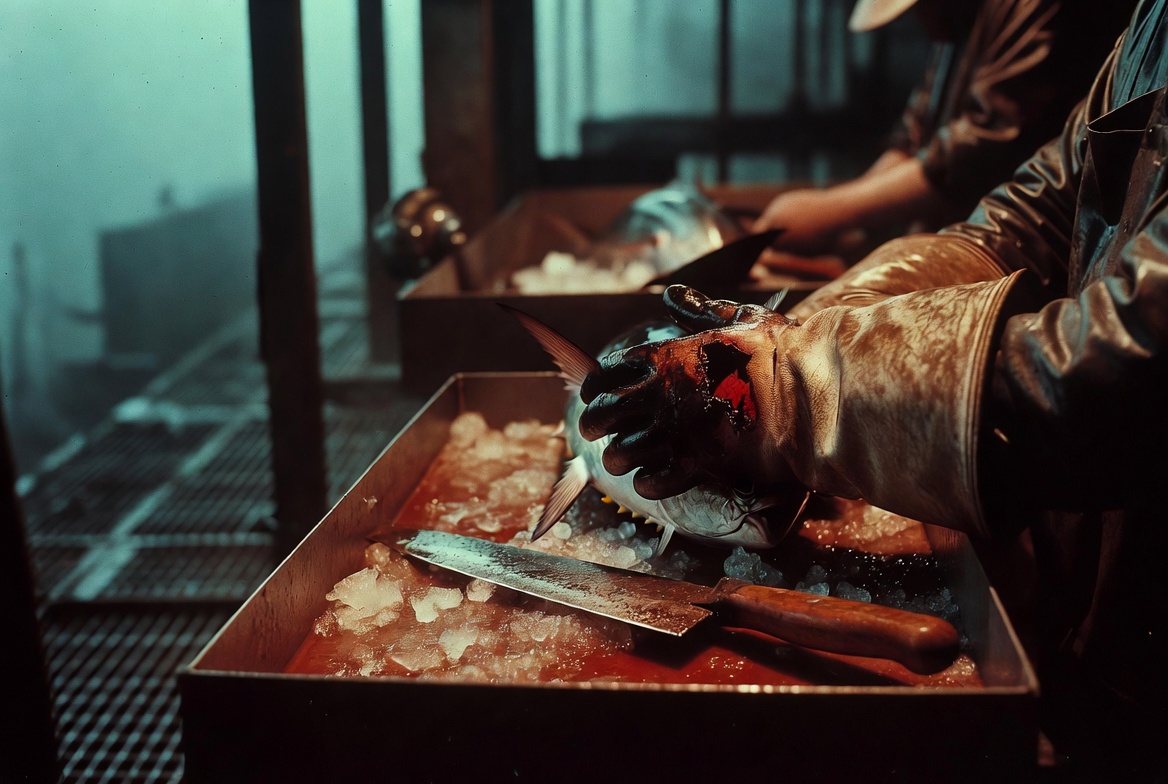
In October 2024, Bowo boarded the Oryong 306 in Busan. It was his third Korean ship, after the Chilsung and the Daehwa. His contract listed him as an ordinary deckhand. Aboard, he was put at the fish-cutting table — work that, he says, should have paid more.
The first mate promised an extra hundred dollars a month. The promise was made verbally, in front of the bosun and the senior crew.
Bowo’s contract ended in December 2025. He never received the raise. “By the time the contract finished, nothing,” he says.
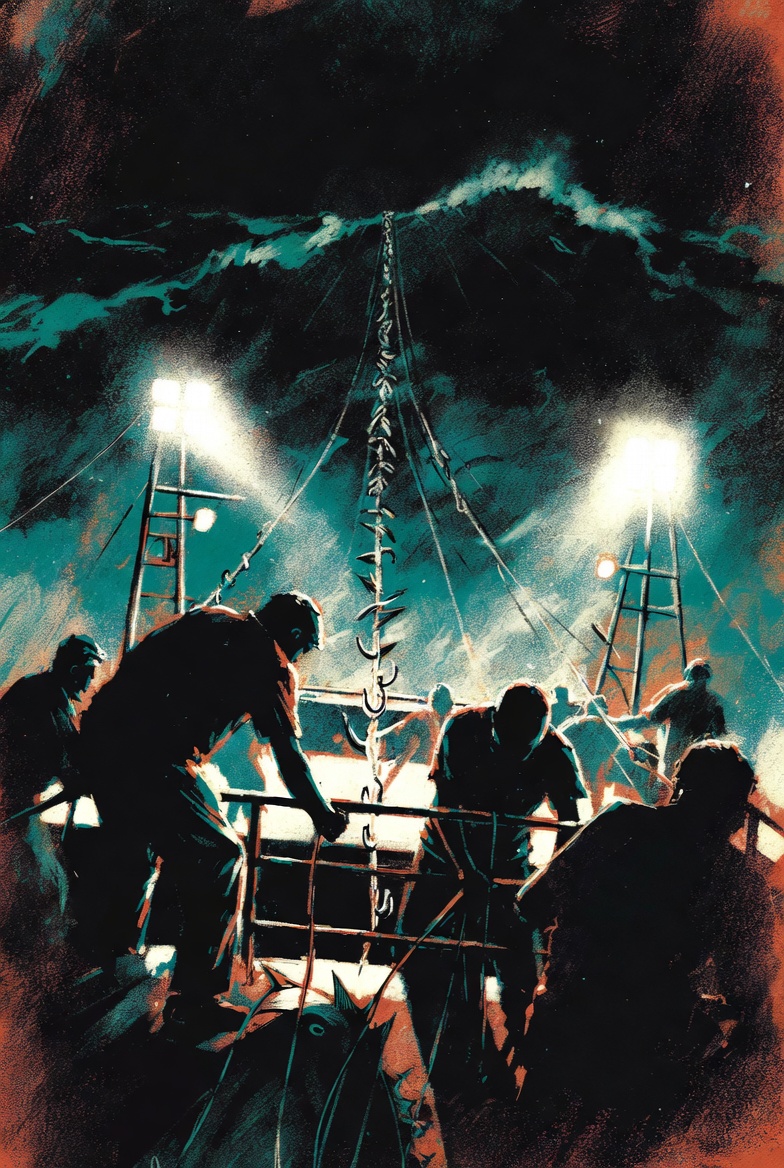
The workday begins before sunrise. The lines are hauled, the fish brought up, then cut and frozen. In a heavy season the work can run more than a dozen hours with no certainty of when it stops.
But what marked those fourteen months most was not exhaustion — it was thirst. The Oryong 306’s freshwater maker, Bowo says, was broken from the start of the voyage. Clean water flowed normally only for the first two weeks, while the ship was still heading to the fishing grounds. Once operations began, the supply all but stopped. “Fourteen months, and only fourteen days of clean water,” Bowo says softly.
The crew complained to the captain. The answer was always the same: the machine would be fixed. By the time the ship docked again, it still did not work. So the Indonesian crew caught water from the air-conditioning drain pipe, boiled it, and drank it. Meanwhile the bottled water brought from shore stayed in the officers’ quarters, reserved for the Korean crew.
“Clean water really is essential. But out there the drinking water was controlled by the captain and the mate. We couldn’t just ask for it whenever.”
— Bowo, crewman, Oryong 306
Aboard the ship there was another instrument of control, one not spelled out in the contract. As the voyage neared its end, the captain graded each crewman A, B, or C. The grade determined the catch bonus.
Bowo felt he had worked fully from day one. His finger had been cut by the trimming knife; as soon as the wound closed, he went back to the table. Yet his grade still fell, he says, after “a small quarrel with the first mate.” One argument could erase a year’s bonus. At sea, there was no higher authority to correct the captain’s decision.
Officially, the Korean government provides a complaint number posted on the ship’s wall. But it can only be reached over the internet. On the Oryong 306, Wi-Fi access was in the captain’s hands.
“The Wi-Fi was switched off,” Bowo says. “There was nothing you could do.”
A complaint channel reachable only through a network controlled by the very person being complained about is, in the end, not a complaint channel at all.
Nineteen months, twelve of them without land
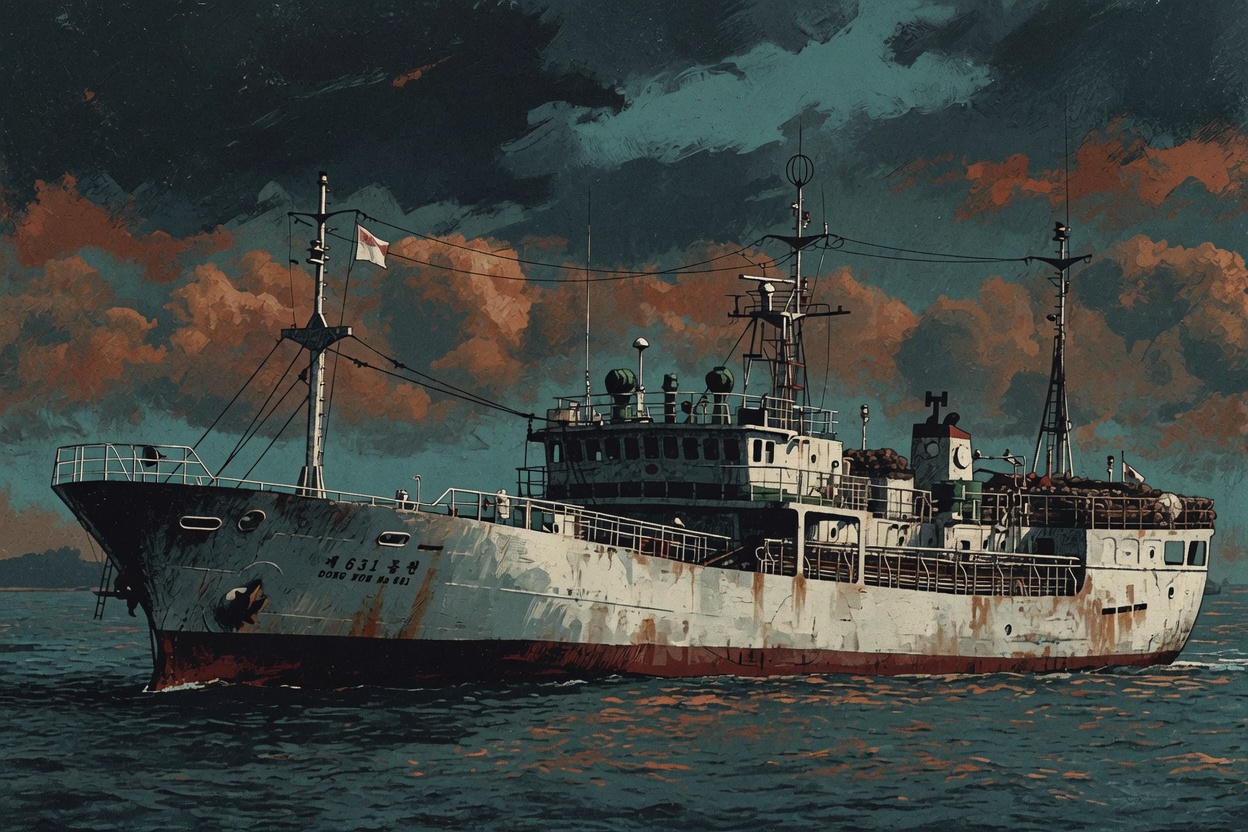
Joko, a crewman from Bulakamba, Brebes, sailed twice on the Dongwon 632 — most recently July 2024 to February 2026. From Busan, his ship made the long crossing of the Pacific to waters near Peru.
Green dots: the Dongwon 632’s meetings at sea. The farther southeast, the farther from any port — and the more dependent on reefers.
Click a dot for its date & details
The Bathroom Was Only for the Koreans
Bowo’s account is not the story of one ship with one captain who happened to be cruel. Joko — not his real name — is from Bulakamba, Brebes. He sailed twice on the Dongwon 632, most recently from July 2024 to February 2026. By his measure, the captain there counted as “easygoing”: he never hit anyone, only cursed.
“Really it was just, ‘watch it, you dog,’ that sort of thing,” he recalls.
That a captain who merely cursed was considered good tells you the standard that prevailed aboard.
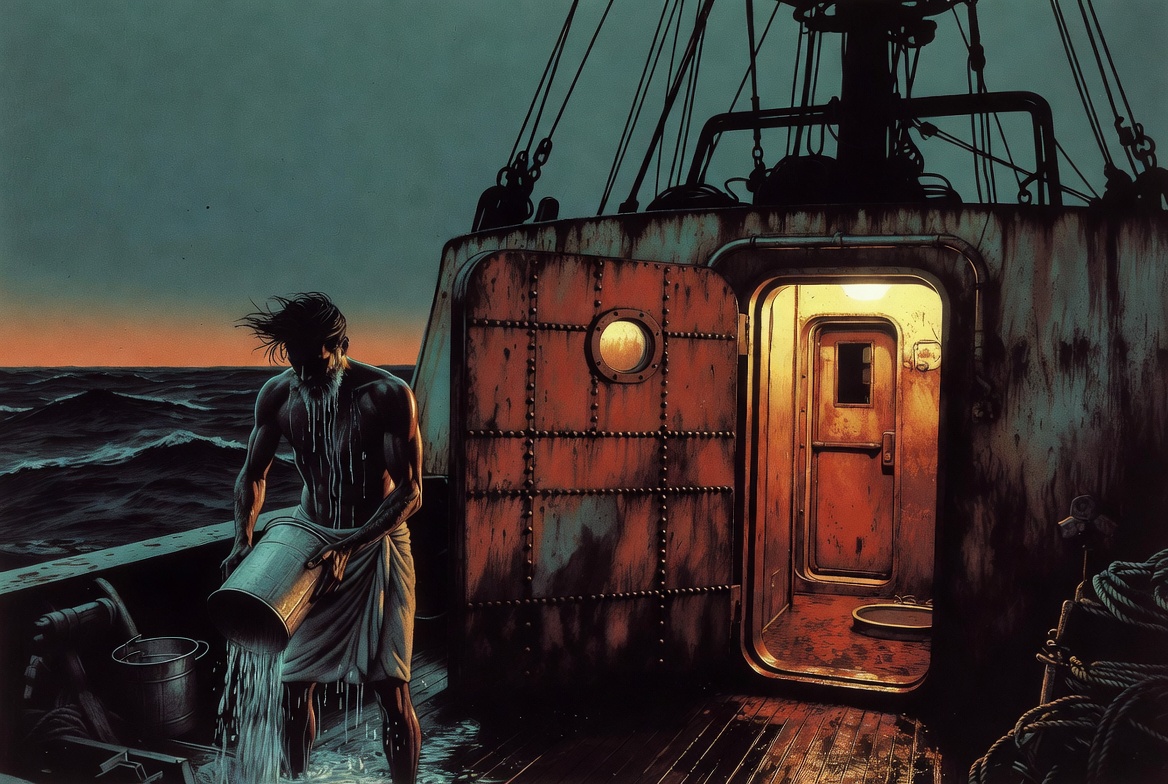
The divide between the Korean crew and the Southeast Asian hands reached down to the most basic needs. The one bathroom was reserved for the five Korean crew. Twelve Indonesian and Vietnamese crew bathed on the open deck with seawater, then rinsed off as best they could.
Bottled water, too, was for the Korean crew. The others drank distilled water. Wi-Fi ran without interruption for the officers, but was rationed to three hours for the crew and cut off at midnight.
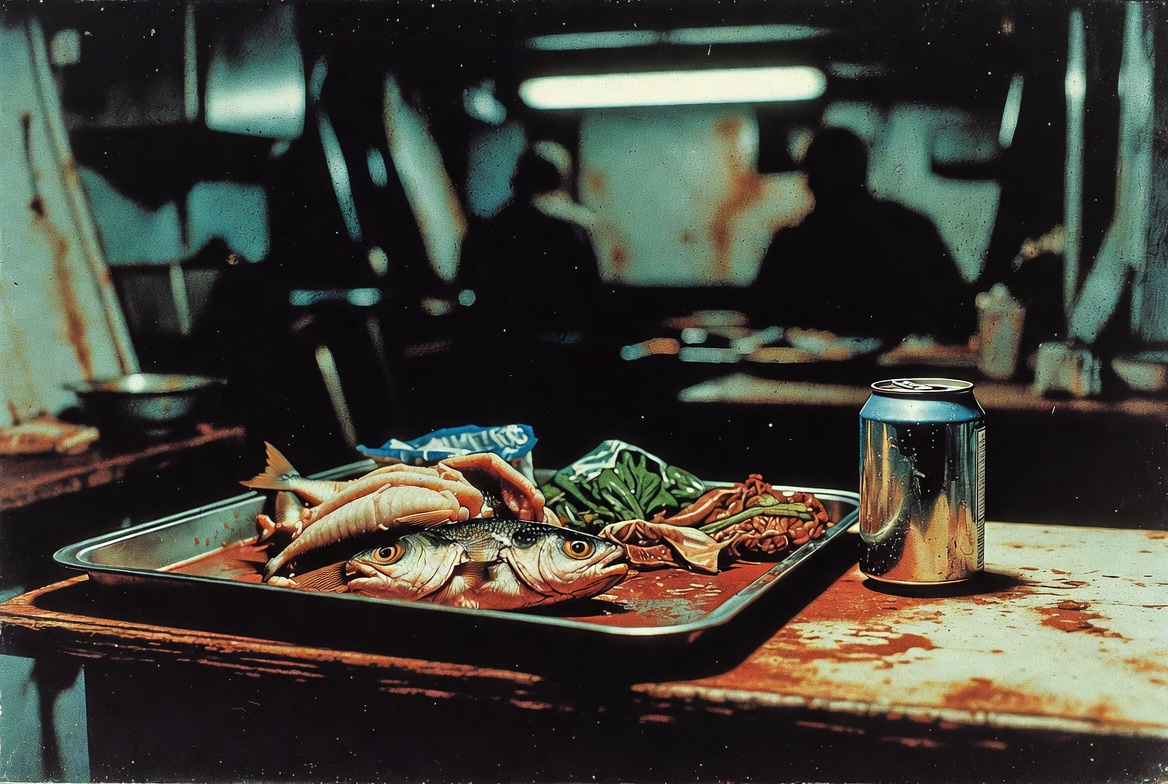
At the table, the morning dish was often fish heads left over from the cutting. The afternoon dish was served again for dinner. Joko still remembers packaged vegetables three months past their expiry date and a can of Coca-Cola more than a year past its date.
Joko’s base pay was 600 dollars a month — up from 390 dollars on his first contract in 2019 — for workdays that could reach fifteen hours. What his Korean-passport shipmates earned will appear in that government’s own official documents. The gap is not merely a matter of experience or rank; it is part of a labor structure that places all foreign crew on the bottom rung.
There was one detail from Joko that later became the key to reading the ship’s tracks.
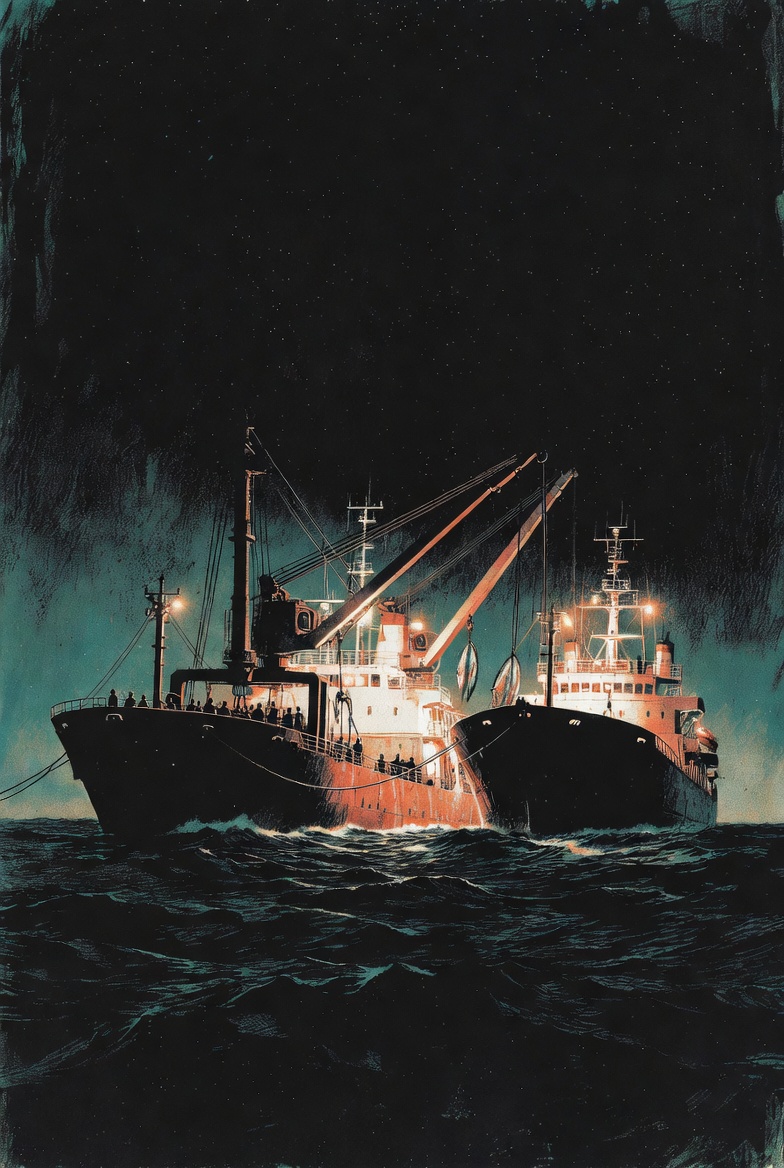
For the first twelve months, the Dongwon 632 did not touch land even once. Yet its holds were emptied regularly. Every three or four months, a refrigerated carrier pulled alongside in the open sea. Joko remembers one of their names as “Seyu.” Frozen tuna was moved from one hold to another, far from any port.
The practice is called transhipment. It is legal when reported and monitored. But the same practice also lets a fishing vessel stay at sea for months, keeping the catch — and its crew — away from any port inspection.
Eyes in the Sky
Bowo’s and Joko’s stories are hard to prove by ordinary means. All that exists is the crew’s account set against the company’s — and the events unfolded thousands of kilometers from land, with no reporter, union, or inspector to witness them.
But ships leave tracks.
Commercial fishing vessels generally broadcast an Automatic Identification System, or AIS, signal that transmits identity, position, speed, and heading. Satellites capture that signal; Global Fishing Watch then turns it into data on vessel movement, fishing activity, meetings at sea, and the periods when the signal disappears.
For this story, we traced five years of movement records for South Korean–flagged vessels, from May 2021 to May 2026. The data cannot show what happened in the engine room, at the mess table, or in the crew quarters. Nor does it by itself prove a violation. But it lets us test key parts of the crew’s testimony: how long a ship stayed at sea, where it fished, which carriers it met, and when its track went dark.
Each dot marks a location of South Korean–flagged vessel activity recorded by satellite: 126,781 vessel-to-vessel meetings, 3,412 signal-loss events, 4.6 million fishing events.
Using an illegal, unreported, unregulated fishing risk score — how often the AIS was deliberately switched off, activity inside marine protected areas, transhipment patterns — we screened out the 212 most suspicious vessel identities. In red: their 23,202 incident points.
You can explore the full list yourself at the end of this section.
Vessels on the suspicious list deliberately switched off their transponders 1,932 times over five years — vanishing for hours or days, then reappearing somewhere else.
Dashed lines: the 68 times the KINGSTAR went “dark” — from the point where the signal was lost to where it reappeared. Switching off AIS is a classic indicator of IUU fishing.
One carrier fleet coded CT3-4412 — 23 vessels — logged 400 to 1,525 meetings at sea per vessel over five years. The CT3-4412-17 alone: almost once a day.
This is the infrastructure that lets a fishing vessel avoid returning home — and keeps its crew from coming home.
The carrier was named SEIYU
Joko named one carrier: “Seyu.” In the satellite data, the carrier SEIYU is recorded pulling alongside the Dongwon 632 on 7 December 2024 in the Eastern Pacific — right in the middle of Joko’s contract.
Then the HANARO (22 March 2025), then the GENTA MARU (17 June 2025) — exactly the “once every three or four months” interval he described. The SEIYU is also recorded pulling alongside the Oryong 306, Bowo’s ship.
Testimony from the deck, checked against the satellites: a match down to the name and the date.
Click a dot for details
Eleven Ships in an Antarctic Sanctuary
Eleven Korean vessels were detected operating inside world-class marine conservation areas — the Ross Sea Region Marine Protected Area, the largest marine protected area on Earth, along with the protected waters of South Georgia and Bouvet Island.
Most of it is not poaching: vessels like the Kingstar and Sunstar hold CCAMLR licenses and fish in the Special Research Zone, the one part of the protected area open to licensed toothfish fishing. What stands out is the combination — they do it while repeatedly switching off their AIS, and with Indonesian crew on deck.
Top-down view of Antarctica (azimuthal projection), raster basemap. Each dot = a fishing activity classified by Global Fishing Watch inside a protected area, 2021–2026. Hover for the vessel name & coordinates.
Behind those hundreds of thousands of records, a few vessels stand out.
The vessel that “disappears” most often in the entire fleet — 139 AIS shutdowns. Its name is Chinese, its flag registered as Korean, and the MMSI identity it broadcasts does not conform to international standards. A similar vessel: CHANG RONG 3-5 (47 times).
The Kingstar fishes for toothfish under license in the Ross Sea Special Research Zone — legal — yet switched off its AIS 68 times. A vessel that obeys the catch rules but often vanishes from the public screen.
This vessel, with 45 AIS shutdowns, is recorded pulling alongside the Dongwon 632 — Joko’s ship — on 20 December 2025, in the open ocean near Peru. The “dark” ships and the witnesses’ ships share the same sea.
Of the 212 suspicious vessel identities, only 168 are unique hulls — some vessels appeared under more than one AIS identity over five years. Switching identity at sea is a classic tactic of IUU fleets.
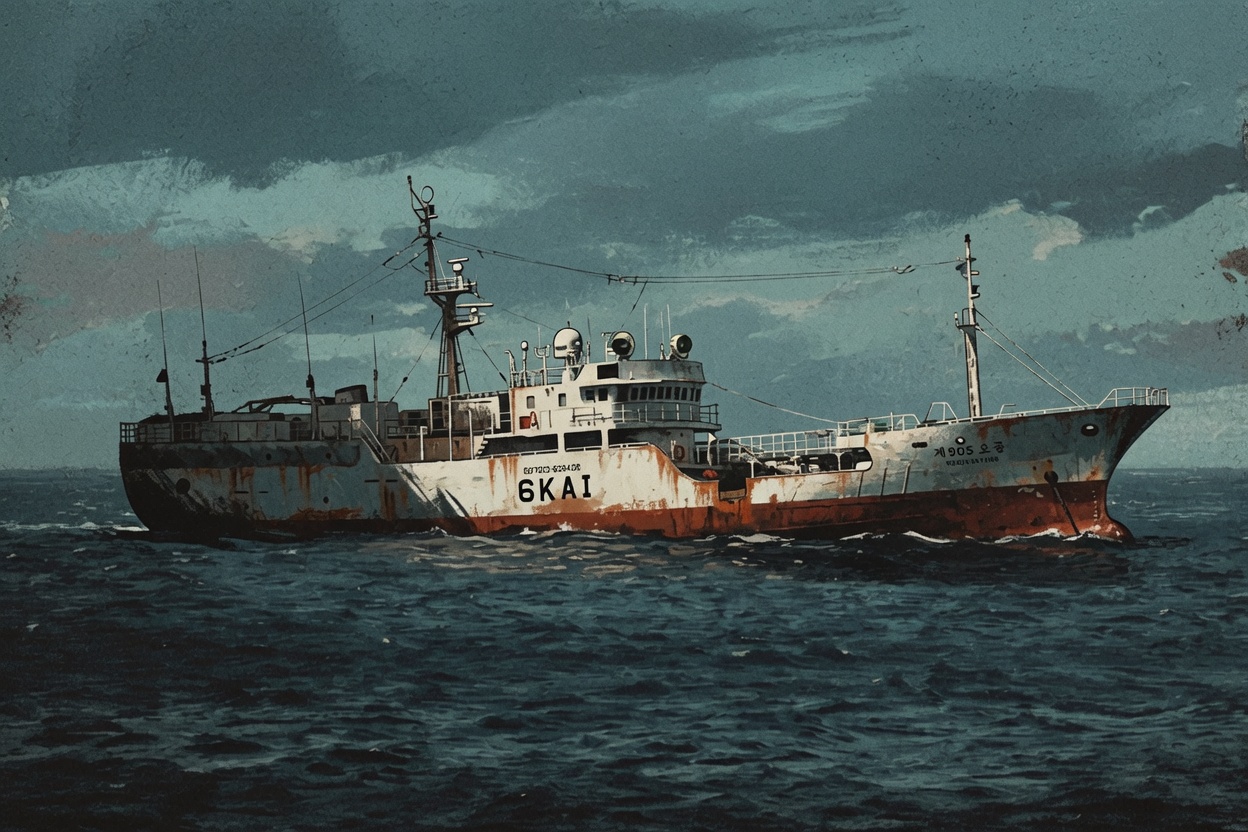
The No.805 Oryong, for instance, was repeatedly detected in movement patterns that Global Fishing Watch classifies as fishing activity in the Hatton-Rockall vulnerable marine ecosystem, North Atlantic. The vessel also had 19 periods of AIS signal loss.
Algorithmic findings like these still need to be read with care. A point inside a protected area does not necessarily mean illegal fishing; the rules differ by area, and the final judgment requires catch records, licenses, and official monitoring data. The same goes for lost AIS: the device can fail, satellite reception can drop out, or the transponder can be switched off deliberately.
What matters is the pattern. When a vessel repeatedly disappears over the fishing grounds, or reappears just before meeting a carrier, we will struggle to reconstruct what happened during the gap.
For the crew’s story, that gap is not merely technical. A ship invisible from shore is also further from any oversight of the people aboard it. AIS does not record violence, but it shows how long a ship and its crew stay out of reach.
The Environmental Justice Foundation has documented the link between weak transparency in fishing operations and a high risk of abuse against crew in Korea’s distant-water fleet. It does not mean every vessel that loses its signal mistreats its crew. But both problems grow from the same space: long operations, far from port, with oversight that depends on the captain and the company.
Bowo once saw for himself how fishing decisions rested entirely with the officers. On one ship where he worked, he says, fishing he considered illegal “happened for a while, but was then forbidden by the captain” after worries arose that it would be found out.
The satellites cannot hear that order. They only record the ship moving — or suddenly vanishing.
Score = a combined IUU risk index (deliberate AIS disabling, activity inside protected areas, transhipment intensity). Click a row for details and tracking links for each vessel — including a photo search in public shipping databases. Appearance on this list is a risk indication from satellite data, not a verdict of any legal violation.
Names on the Ghost Ships
Satellites only recognize a ship’s hull. They do not name the people working aboard it.
Those names surface from the recruiting agents’ documents.
One of the fifteen officially registered Indonesian crewing companies works with KNI-KIMCO, a Busan-based Korean agent. In a roster once posted publicly, it recorded 319 placements of Indonesian crew onto 70 Korean vessels across 2021 and 2022, complete with crew names, ship names, and departure dates.
We matched that list against the 212 vessel identities selected from the satellite analysis on the basis of risk indicators: AIS loss, fishing activity in sensitive areas, voyage duration, and patterns of meetings at sea.
Thirteen of the 70 vessels in the roster appear on the screened list. Nine of them match down to the IMO number or another hull identity stronger than a mere name coincidence.
Counted by crew placement, 125 of the 319 placements went to vessels on that screened list. But the number of unique identifiable people is 122. The difference arises because some names are recorded more than once.
That figure does not mean those 122 people were victims, let alone perpetrators of any violation. A satellite-based screening is also not a legal ruling. It merely shows that many Indonesian crew were placed on vessels whose operations warrant closer scrutiny.
Four names, for instance, are recorded boarding the Blue Ocean in April 2021. That CCAMLR-licensed toothfish vessel operated in the Ross Sea, Antarctica, and had 21 periods of AIS signal loss.
Three names are recorded on the Green Star, another toothfish vessel whose tracks reach the waters of South Georgia. Two names were on the Dongwon 622, in the same fleet family as Joko’s ship. Eight other names are recorded on the Oyang 99 — a fleet name that recalls the Oyang 75, the ship that dozens of Indonesian crew walked off at a New Zealand dock a decade earlier.
A shared fleet name does not automatically prove identical conditions on every ship. But this roster opens one important window: behind the dots, the lines, and the hull numbers are Indonesian workers who left through official channels.
They came to earn a living. Some then ended up on ships that vanished from tracking, operated in hard-to-monitor waters, or went months without touching port.
Official figure as of end-2024 — 80% of all foreign crew in Korea’s distant-water fleet.
Public roster of the KNI-KIMCO agent (Busan): names, ships, and boarding dates of the Indonesian crew it dispatched.
Nearly one in five of this agent’s vessels is on the suspicious list. 9 match down to the IMO number.
125 of 319 placements landed on flagged vessels — nearly four in ten. Real people aboard ships that switch off their transponders, from the licensed ones in conservation areas to those that vanish on the high seas.
Each square is one placement. ■ = onto one of the 13 flagged vessels — nearly four in ten. Hover or click a ship name below to highlight its squares, and to open the list of names (masked for the crew’s safety).
Source: KNI-KIMCO public roster cross-checked with this story’s GFW analysis. Names are masked (pattern S*****M) to protect the crew, who are victims and not perpetrators; the focus is on the vessels and their operators. Open the full visualization & methodology ↗
Where the Fish Goes
Transhipment can blur the origin of the fish, but it does not entirely erase the trail of its journey.
When a carrier pulls alongside a fishing vessel, then sails for port, the satellites record both events. From the meeting points at sea, we traced each carrier’s port visits in the Global Fishing Watch data, then connected the path: from the fishing grounds, to the carrier, to the unloading dock.
That trace found three main routes. Each shows a different face of Korea’s fishing industry — from tightly monitored premium fisheries to catch that moves onto Chinese ships before ever reaching land.
Each arc = a catch route from the fishing grounds to the unloading port (assembled from Global Fishing Watch carrier tracks). Click a route to highlight it.
Source: tracks of meetings at sea (GFW encounters) + each carrier’s port visits (GFW port-visits), compiled for this story; ownership verified via CCAMLR & industry records. Hover/click a path for details. Numbers on the labels = recorded port visits, not tonnage.
The first route is Antarctic toothfish.
The Blue Ocean, Green Star, Kingstar, and Sunstar — all Korean-flagged, owned by TNS Industries — were detected operating in two marine protected areas: the Ross Sea Region Marine Protected Area in Antarctica, and the waters of South Georgia. Of 128 points that Global Fishing Watch classifies as fishing activity inside the Ross Sea MPA, 124 fall within the Special Research Zone — the part of the protected area that is in fact open to licensed toothfish fishing for research and management purposes.
So where did the remaining four points fall? All four lie outside that zone, in the part of the protected area closed to fishing — the General Protection Zone. All of them hug the northern boundary of the Special Research Zone, at 73 degrees 30 minutes South. Too few and too close to the line to call a planned hunt in a forbidden zone, but enough to be a question only the vessel’s catch records and VMS data can answer.
These ships do not rely on transhipment to bring in their catch. The port tracks show their loads carried mostly straight to Punta Arenas, Chile — one of the main gateways of the toothfish trade, sold in American and European markets as Chilean sea bass.
This route matters not because all of its catch is illegal. Quite the opposite: it shows that Indonesian crew also work at the most premium, most documented, most tightly monitored end of the industry. Fish certification does not automatically guarantee the conditions of the people who catch it.
[Awaiting an interview with Blue Ocean crew.]
The second route is the Dongwon fleet’s tuna.
This fleet operates far out in the Eastern Pacific, in open waters near Peru — thousands of kilometers from any land. It was there that the Dongwon 632, Joko’s ship, spent its first twelve months without touching port even once; its track can be seen on the map in Joko’s testimony section.
From those waters, the Dongwon vessels hand their tuna to Korean-flagged carriers that then unload mostly in Busan, the city where Dongwon Industries is headquartered. Dongwon owns StarKist, one of the largest canned-tuna brands in the United States. Joko worked on the Dongwon 632; two other crew we traced, Jayadi and Sobri, were once placed on the Dongwon 622.
[This supply chain is still being traced.]
The third route is squid and saury from the Northwest Pacific.
Since 2024, a number of Korean-flagged vessels — including the 301 Samyoung and 517 Sungkyung — have repeatedly met two Chinese carriers, the Yong Fa Yun 10 and Yong Fa Yun 12. Each of the two Korean ships had 34 periods of AIS signal loss. After taking on their loads, the Chinese carriers are recorded heading to Shidao and Zhoushan, two major hubs for landing and processing seafood.
Those waters are managed by the North Pacific Fisheries Commission. Transhipment is not banned, but it must be recorded and reported. Until 1 April 2026, there was no requirement for an independent observer aboard the carrier to witness each transfer directly.
That means, for meetings before that date, the public relies chiefly on reports from the operator and the flag state. When a transfer is preceded by a period of lost AIS, the origin, amount, and journey of the catch become even harder to verify from outside.
These three routes carry the fish to port. But one final stretch remains not fully visible: from the unloading dock to the buyers, the factories, the brands, and the end markets.
[This stretch of the supply chain is still being traced.]
The World’s Priciest Fish, Its Cheapest Crew
On the menus of expensive restaurants in America and Europe, the fish is called Chilean sea bass. A single portion can sell for 50 dollars.
Its real name is toothfish — a fish that lives in the cold waters of the Southern Ocean, some at depths of more than a thousand meters. Those who haul it onto the deck, clean it, then pack it into the freezer hold are crew who come, among other places, from Brebes and Tegal.
The Green Star is a South Korean–flagged bottom longliner owned by TNS Industries. From the Indonesian recruiting agent’s roster we matched against Global Fishing Watch data, three Indonesian crew are recorded as placed on that ship.
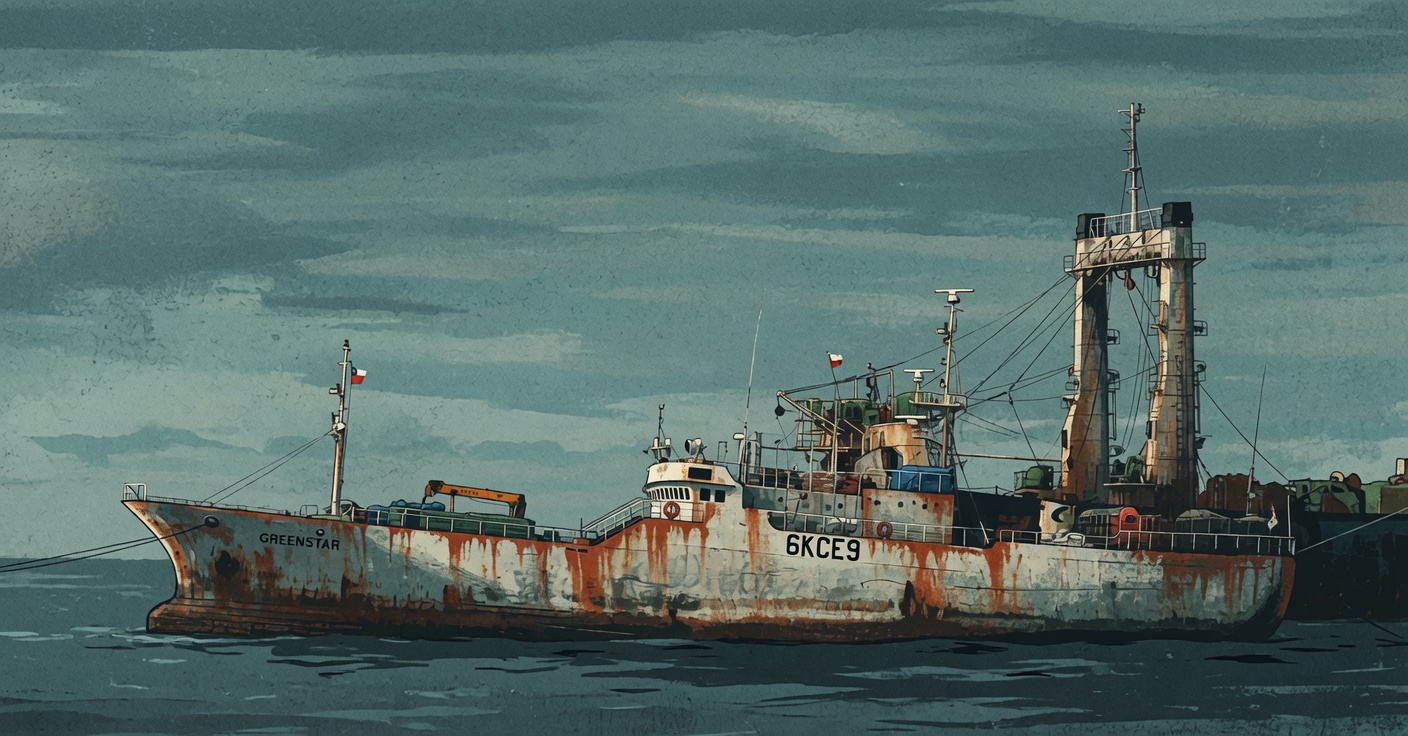
The Green Star is not a ship operating outside the system. Its name appears in the CCAMLR List of Vessel Authorisations, the register of vessels permitted to catch toothfish in the Southern Ocean. This fishery is among the most tightly monitored: ships must carry a monitoring system, report their catch, and host a scientific observer during the voyage.
Toothfish from this chain is marketed as a premium product with quotas and certification.
Here is the paradox.
The industry can know from which patch of sea the fish was caught, what the quota was, even which seabird species risk being snagged on the hooks. Yet the protection of the people who haul that fish aboard is not always as meticulous as the protection of the catch.
Crew exploitation does not stop at the fleets branded as dirty. It can also live within a supply chain that is legal, certified, and ends at an expensive restaurant table.
The satellite data then reveals another problem. Even in a fishery regulated patch by patch, the Green Star’s tracks raise questions about whether where it operated matched the license on record.
CCAMLR does not issue a single blanket license to “catch toothfish in Antarctica.” The Southern Ocean is divided into subareas and statistical divisions. Each vessel receives authorization for a specific area and season. A license for one patch does not automatically apply to the patch next to it, and it does not last forever.
In the Atlantic sector, Subarea 48.3 covers the waters around South Georgia. Subarea 48.2 lies around the South Orkney Islands. Farther east is Subarea 48.6, which covers the waters toward Bouvet Island and the region to its south.
For the season 1 December 2025 to 30 November 2026, the CCAMLR authorization list we examined lists the Green Star for Subarea 48.6.
But the tracks that Global Fishing Watch classifies as fishing activity do not appear only there.
On 27 December 2025, the Green Star was detected in a fishing movement pattern in Subarea 48.3, the waters of South Georgia. On 29 January 2026, a similar pattern appeared in Subarea 48.2, around the South Orkney Islands.
The clearest finding came on 3 to 6 May 2026. Over four days, Global Fishing Watch logged seven fishing events around 54 degrees South and 36 degrees West — Subarea 48.3, roughly 2,500 kilometers west of the 48.6 area named in its authorization.
The timing matters too. The activity appeared just after the South Georgia toothfish longline season opened on 1 May.
Think of a CCAMLR authorization as a driver’s license valid only for certain roads. The Green Star’s card, in every season we checked, never listed the South Georgia or South Orkney “roads” — in 2022/2023 and 2023/2024 it was listed for Subarea 88.3, then moved to 48.6. Yet its tracks turn up on roads that were not its to use.
We doubted that May data ourselves at first. Our early dossier noted that the Green Star last transmitted in October 2025 — if true, activity in May 2026 would be impossible. So we pulled it again straight from Global Fishing Watch’s raw data. It turned out the ship’s signal was still active until 11 July 2026; our old record was the one that was wrong.
And seven operations over four days in the same spot is not the pattern of a ship merely passing through — it is the pattern of a ship that is fishing.
The conclusion is hard to avoid: the Green Star fished for toothfish far outside the patch of its license. Not one stray occasion, but three times in a single season — twice at South Georgia, once at the South Orkneys — in waters that, across the entire archive of authorizations we examined, were never its to fish.
This is not a matter of misreading a map. A ship that sets its lines 2,500 kilometers from its authorized area, right on the opening day of the South Georgia season, is fishing where it has no right to be.
We have put these findings to TNS Industries, the South Korean Ministry of Oceans and Fisheries, and the Government of South Georgia and the South Sandwich Islands for response. [their responses to come]
For a decade, anger over the fate of Indonesian crew on the high seas has more often been aimed at ships plainly on the edge of the law: ships that switch off their AIS, hide their catch, or bury their crew at sea.
The Green Star does not fit that picture.
It is registered, licensed, monitored, carries an observer, and supplies certified fish to premium markets. Yet it is precisely a ship like this that reveals the more fundamental problem: the legality of the catch and the decency of the work are two different things.
A fish can carry a certificate of origin, a quota, and complete scientific records, while the crew who caught it still work for low pay, long hours, and almost no bargaining power.
The spotlight has been too busy looking for the ship that is wholly in the wrong. What it misses is the possibility that even on the ship considered most in the right, things are not right.
And the first to bear it remain those who haul the lines from the sea: crew from Brebes, Tegal, and other coastal towns of Indonesia.
[Awaiting an interview with Green Star crew.]
The Dark Trail of Korea’s Squid Ships in the Pacific
On 26 September 2024, the SKYMAX 101 surfaced in the middle of the Northwest Pacific.
The South Korean–flagged vessel was around 45.6 degrees North and 157.4 degrees East — more than a thousand kilometers northeast of Japan. At that spot, a Chinese-flagged refrigerated carrier was waiting: the Yong Fa Yun 10.
The two ships pulled alongside. The load moved across.
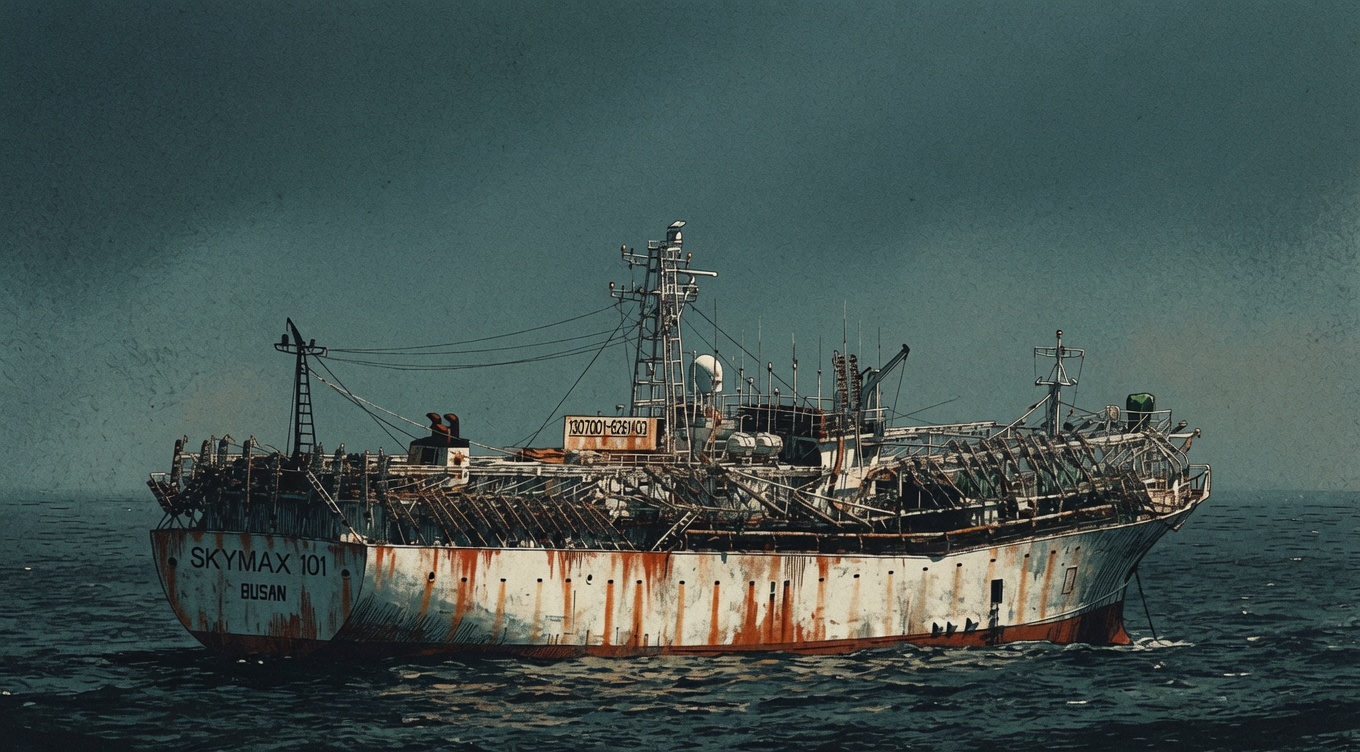
But before that meeting, the SKYMAX 101 had just been invisible in the AIS data for about 83 hours. It reappeared only a day before meeting the Yong Fa Yun 10.
Seventeen days later, the same pattern repeated.
On 13 October 2024, the SKYMAX 101 again met the same carrier. Before reappearing, the Korean ship had lost its signal for about 153 hours — more than six days straight.
Those two meetings were not one-offs.
Across 2021 to 2025, the SKYMAX 101 had 64 periods of AIS signal loss. Add up all their durations and the ship was invisible to public tracking for 1,838 hours, nearly 77 days. The longest stretch ran about nine and a half days without a break.
Lost AIS does not automatically prove illegal fishing. A transponder can fail, a satellite signal can go unreceived, or the device can be switched off deliberately. Public data cannot tell the cause apart in every case.
But the data can show the sequence: the ship disappears, reappears, then meets a carrier.
That sequence repeats across more than one ship.
When South Korea’s distant-water fleet in the Northwest Pacific is traced, four other ships show a similar pattern: the 102 Kumyang, 301 Samyoung, 517 Sungkyung, and 803 Tong Young.
They operate in the same region, between 40 and 50 degrees North, from the waters along the Kuril Islands to the Emperor Seamount. These ships catch squid and saury on the high seas, far from port and hard for patrols to reach.
In that region, their signals repeatedly cut out.
The 102 Kumyang had at least 40 periods of signal loss and seven meetings with a Yong Fa Yun vessel. The 301 Samyoung had 34 periods of signal loss and 13 meetings. The 517 Sungkyung also had 34 periods of signal loss and 12 meetings. The 803 Tong Young logged 30 signal losses and 12 meetings with a carrier.
Together with the SKYMAX 101, these five ships repeatedly met the same two names: the Yong Fa Yun 10 and Yong Fa Yun 12.
The two Chinese ships are reefers — vessels with refrigerated holds that work like floating freezer warehouses. A reefer’s presence lets a fishing vessel stay at sea. The catch is transferred while the fishing vessel goes back to work without needing to dock.
The fish goes home. The ship and its crew stay behind.
After taking on their loads, the Yong Fa Yun 10 and Yong Fa Yun 12 are recorded heading to Chinese ports, mainly Shidao and Zhoushan. Both are important hubs for landing and processing seafood.
There, the origin of the catch becomes harder to follow. Squid or saury that was once on a Korean ship has moved onto a Chinese one. Once unloaded, the cargo can enter a warehouse, a market, or a factory together with catch from other ships, then be refrozen, cut, and packaged.
Transhipment does not erase the origin of the catch. But it adds a new layer that separates the fish from the ship that caught it.
A meeting at sea is not in itself a crime.
Fishing in the Northwest Pacific is managed by the North Pacific Fisheries Commission, or NPFC. South Korea and China are both members. NPFC rules allow transhipment as long as the vessels are registered and the transfer is reported as required.
The Yong Fa Yun 10 and Yong Fa Yun 12 are not on the NPFC IUU vessel list. Neither are the SKYMAX 101, 102 Kumyang, 301 Samyoung, 517 Sungkyung, or 803 Tong Young.
That means, based on those public lists, there is no basis to call their meetings illegal outright.
The problem lies in oversight.
Before April 2026, information on what was transferred, how much, and from which ship the cargo came depended heavily on reports from the operator and the flag state. Outsiders did not always have an independent witness aboard the carrier.
NPFC only made an independent observer program aboard carriers mandatory from 1 April 2026. Observers record the identity of the source vessel, the type and amount of catch, the time of transfer, and compliance with procedure.
All the meetings we traced, from August 2024 to September 2025, took place before that requirement came into force.
When cargo is transferred after a fishing vessel has gone undetected for days, there are questions public data alone cannot answer: where the fish was caught, how much there really was, and whether the whole load was recorded correctly.
[Awaiting interviews with crew of the Yong Fa Yun 10 & 12, SKYMAX 101, 102 Kumyang, 301 Samyoung, 517 Sungkyung, and 803 Tong Young on suspected IUU fishing.]
Satellites show a ship’s hull, but not the people living inside it.
The recruiting agent’s roster we obtained lists at least 42 Indonesian crew on three Korean ships operating in the Pacific: 17 on the 7 Dong Il, 16 on the 517 Sungkyung, and nine on the 301 Samyoung.
The last two are among the five ships that repeatedly lost their signal and met the Chinese reefers. The 7 Dong Il is not part of that group of five, but its roster shows how heavily Korea’s Pacific fleet depends on Indonesian workers.
Forty-two names. Three ships. Thousands of kilometers from land.
What Seoul Itself Knows
Crew testimony can be dismissed as the grievances of a handful of people. Satellite findings can be argued away as the reading of an algorithm.
But there is a benchmark that comes from the South Korean government itself.
Documents from Korea’s Ministry of Oceans and Fisheries and official seafarer statistics obtained for this story show that Seoul knows the scale of foreign labor in its fleet — and has repeatedly found violations resembling Bowo’s and Joko’s accounts.
At the end of 2024, Korea’s distant-water fleet employed 4,352 foreign crew on 184 ships. Some 3,469 of them, nearly eight of every ten foreign crew, were Indonesian.
Of those thousands of workers, not one is recorded as an officer. Captains, mates, and chief engineers are filled by Koreans. Indonesian crew sit in the ranks of ratings and deckhands. The difference in nationality meets, head-on, the difference in rank, pay, access to facilities, and power aboard the ship.
Tuna longliners are its backbone: 2,321 foreign crew work on this type of ship — Bowo’s and Joko’s type.
Indonesia 3,469, Philippines 513, Vietnam 254, Myanmar 51, Ghana 52. Source: official Korean seafarer statistics (KOSWEC), as of 31 December 2024.
Eight in ten foreign workers in Korea’s distant-water fleet are Indonesian. The industry stands on their backs.
All 4,352 foreign crew hold the rank of rating. There is no career path: an Indonesian can work 15 years and remain the lowest hand aboard.
The Ministry of Oceans and Fisheries’ labor inspection reports across 2023 and 2024 read like the crew’s testimony rewritten in the language of bureaucracy.
In the first quarter of 2023, the government inspected 182 ships employing 4,344 foreign crew. Inspectors found 13 cases of beating, 79 cases of verbal abuse, and three cases of sexual harassment. The report also noted that nearly every company charged the crew for internet.
The third-quarter inspection that year found 15 ships in breach of the minimum-rest requirement of 77 hours a week. A number of crew were paid below the 554-dollar minimum wage. Among them were eight crew on four ships owned by Sajo Industries, owner of the Oryong fleet. The shortfall was paid only after a government reprimand.
Another finding concerned travel documents.
After an Environmental Justice Foundation report in mid-2023, government inspectors found crew passports kept in a locked bag in the captain’s cabin. The practice, their report said, “occurs widely in the field.” Some 187 ships from 33 companies were then ordered to correct how they stored passports.
In the same inspection, a hundred crew were recorded handing over between a fifth and two-thirds of their pay to be “saved” by the recruiting agent until they left the ship. The Korean government itself acknowledged the scheme is easily read as a bond to keep crew from abandoning their contracts.
In October 2024, government inspectors together with EJF and the legal-aid group APIL boarded a tuna longliner freshly docked in Busan after nearly two years at sea. Aboard were 16 Indonesian crew.
Their passports were held by the captain throughout the voyage. The work-hours logbook was filled in by the officers, while the crew were only asked to sign. Some crew said they worked 16 to 20 hours a day. Wages were withheld for months. The complaint QR code was posted only after the ship reached port.
The report’s conclusion was written in a cold sentence: enforcement in the field was “generally inadequate.”
The penalty is far smaller than the harm.
The ministry’s 2024 “ships under guidance” list records a vessel proven to have withheld Indonesian crew’s passports, alongside alleged beating and harassment, fined between 1.6 million and 2 million won — about 17 million to 21 million rupiah.
Roughly the price of a pair of Jakarta–Seoul plane tickets.
On one ship, the list of violations contained a line that sounds familiar after hearing Bowo’s story: bottled drinking water was not provided.
So this is not a dark channel entirely beyond the state. The agent who dispatched Joko is part of a network of official recruiting companies partnered with Korea’s distant-water fishing association. His ship was registered. His crew were on record. Inspections were carried out regularly.
The system was official from start to finish.
And that same system still produced men who came home after months of drinking air-conditioning runoff.
≈ a pair of Jakarta–Seoul tickets
Source: labor inspection reports & the “ships under guidance” documents of South Korea’s Ministry of Oceans and Fisheries, 2023–2024.
The Law That Stops at the Dock
How can 20-hour workdays, 600-dollar wages, and drinking water rationed by nationality survive within an official system?
The answer begins with the crew’s legal status.
Indonesian workers in Korean factories, fields, or coastal boats generally enter through work visas, bilateral quotas, and labor law that applies on land. Bowo and Joko did not take that path.
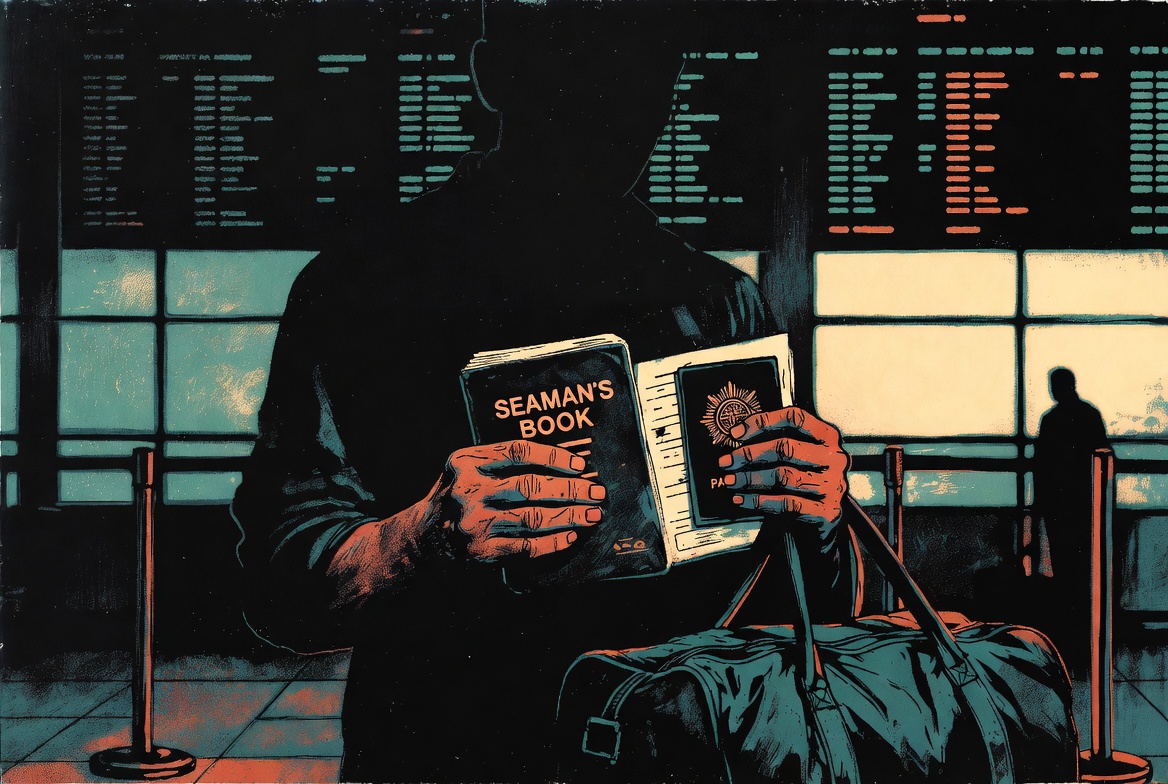
They were recruited by agents in Indonesia, signed a Sea Employment Agreement, then flew to Busan carrying a passport and a seaman’s book. From the airport, they were picked up by an agent, taken to the dock, put aboard the ship, and sent off.
Joko never spent a single night in Korea.
Legally, they are not treated as people working on Korean soil. They work aboard Korean-flagged ships on the high seas, where the flag state is the principal authority that follows the ship wherever it sails.
South Korea has a Seafarers Act that governs working hours, rest periods, overtime, and paid leave. But a number of those protections are excluded or applied differently to fishing-vessel crew.
As a result, the caps on working hours and overtime pay that normally apply to other workers do not automatically protect Bowo and Joko. Korea’s national minimum wage is also not a direct benchmark for foreign crew in the distant-water fleet.
“There’s no such thing as overtime. What’s regulated is rest hours, not working hours.”
— Ari Purboyo, seafarer advocate, Jangkar
Even that lower standard is not always enforced. In the EJF and APIL research, 59 percent of the crew interviewed said they were paid below the minimum wage set for foreign crew.
The working hours they reported fall in the same range as Bowo’s account.
When Bowo says 17 hours a day, he is not describing one unlucky ship. That figure sits in the middle of an industry pattern already documented by advocacy groups and the government.
The world does in fact have an instrument specifically for fishing workers. ILO Convention No. 188 on Work in Fishing sets standards on rest periods, food, drinking water, accommodation, safety, and medical care aboard ship.
Those are exactly the things most missing from Bowo’s and Joko’s stories.
South Korea has not ratified the convention. Indonesia, the country supplying most of its foreign crew, has not either.
Seoul is not entirely without policy. In January 2021, the Korean government launched a plan to improve the human rights of migrant crew on distant-water fishing vessels. Among other things, the plan pushed a wage standard referenced to the international transport workers’ federation. Since November 2023, deducting wages to pay recruitment fees has also been banned.
But an EJF assessment in the years that followed found the reforms had not stopped the violations at sea.
Bowo and Joko sailed from 2024 to 2026, years after the plan was announced. Their stories show the distance between the rules in Seoul and the practice in the middle of the ocean.
The trap also begins in Indonesia.
When he signed up, Joko handed over his original ID card, diploma, and family card to the agent. All of it was held while he was at sea and returned only after the contract ended. Withholding identity documents is one of the ILO’s indicators of forced labor, especially when it limits a worker’s ability to leave the job.
Joko’s basic safety certificate, by his own account, was arranged “all taken care of.” He says he never took the training that was supposed to be the basis for issuing it.
He was sent to one of the most dangerous workplaces on Earth with proof of safety training he never underwent.
On the high seas, the law does not vanish entirely.
It only grows thinner each time the ship moves farther from the dock.
One Big Family: Korea, China, Taiwan
What Bowo and Joko went through is not a new chapter.
It is the continuation of a pattern that for more than a decade has surfaced, been reported, been promised reform, then recurred with different ship names and different crew.
That history shows exploitation on the high seas is not attached to one flag. Chinese and Taiwanese ships more often draw the Indonesian public’s attention. But cases from the Korean fleet reveal the same elements: voyages that run too long, excessive hours, violence, withheld wages, segregated facilities, and crew isolated from the outside world.
Oyang 70 & Oyang 75
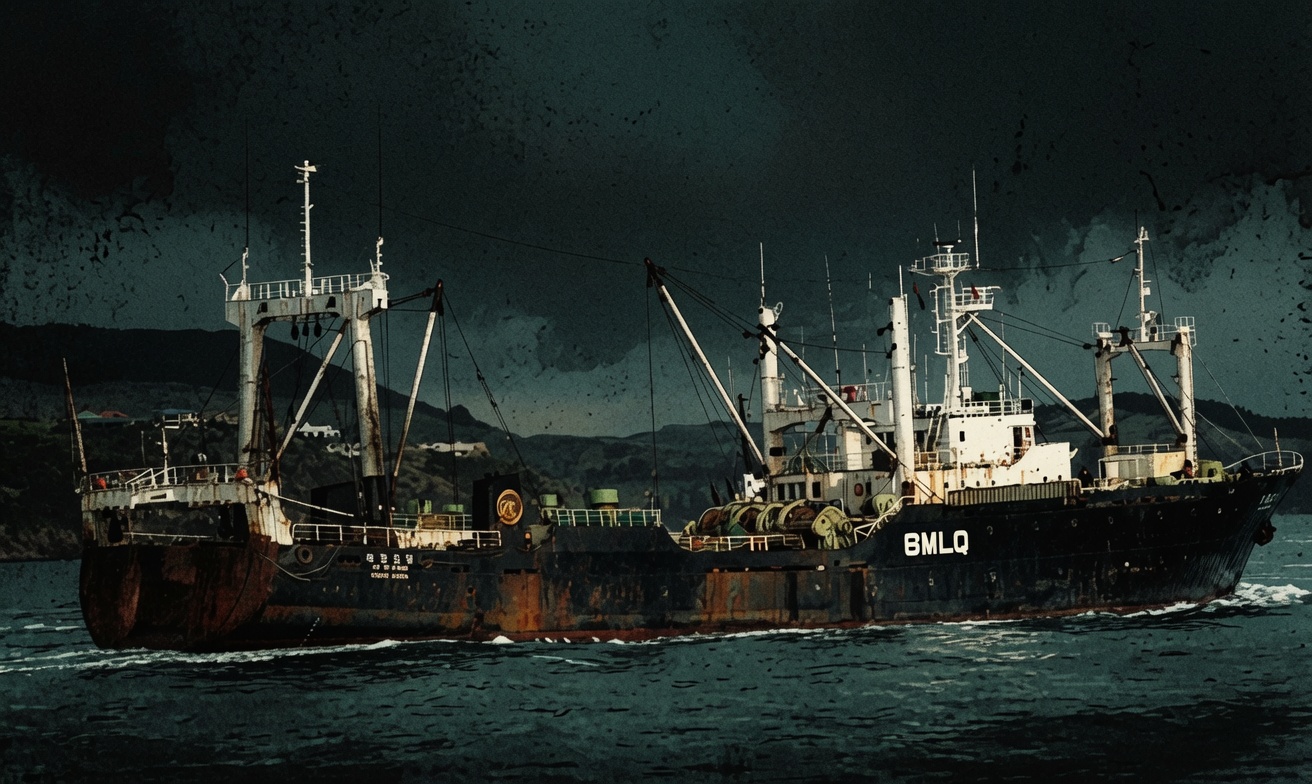
The Korean ship Oyang 70 sank in New Zealand waters; six crew died. A year later, thirty-two Indonesian crew on the Oyang 75 walked off when the ship docked at Lyttelton, carrying stories of stolen wages, physical violence, and sexual harassment. New Zealand answered hard: every foreign fishing vessel was required to reflag to New Zealand so its crew fell fully under the country’s labor law. The flag-state loophole, it turned out, can be closed — given the will.
Oryong 501
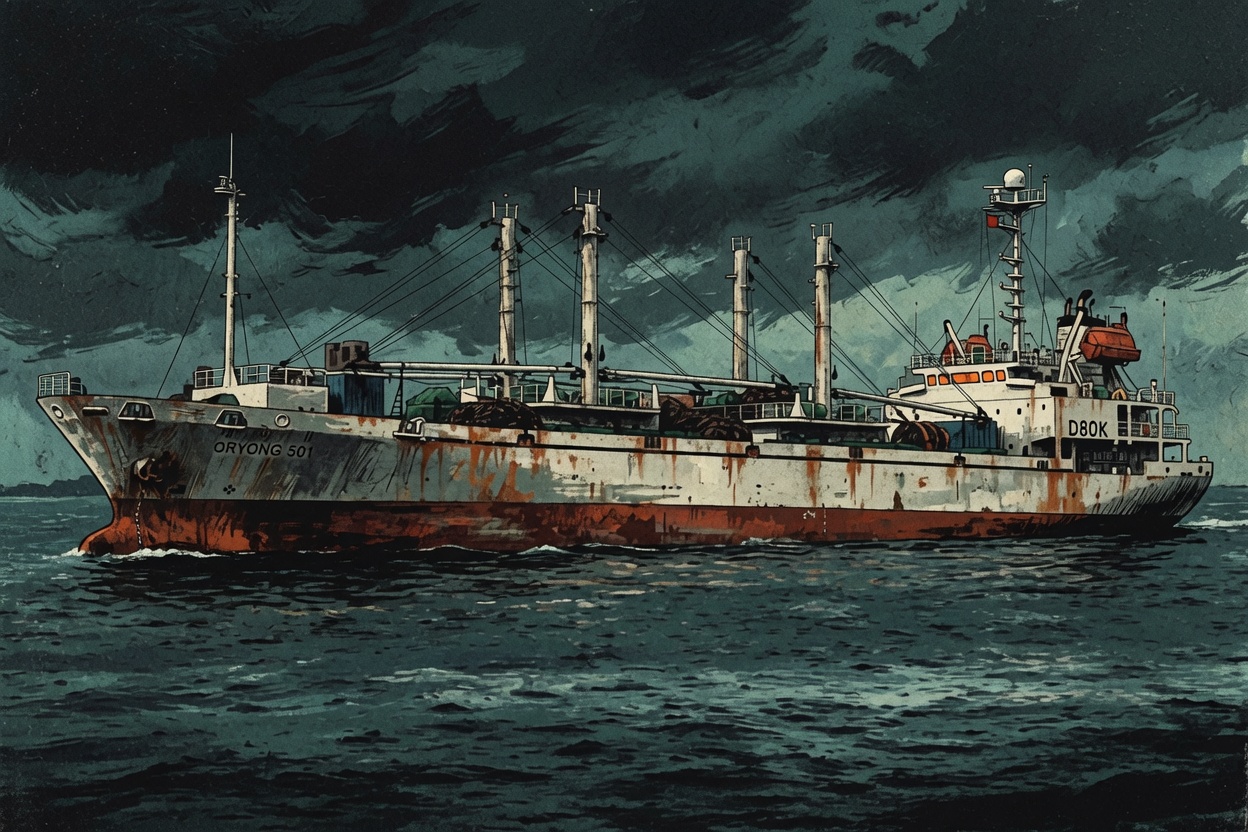
The Sajo Industries vessel sank while fishing for pollock in bad weather. Of some 60 crew, only 7 survived. The dead and missing included 35 Indonesian crew. The same name “Oryong” marked the ship Bowo worked on eleven years later — still with a broken water maker, still with 20-hour days. And the same group, Sajo, appears in Korea’s 2023 government inspection for owing crew wages below the minimum standard.
Longxing 629
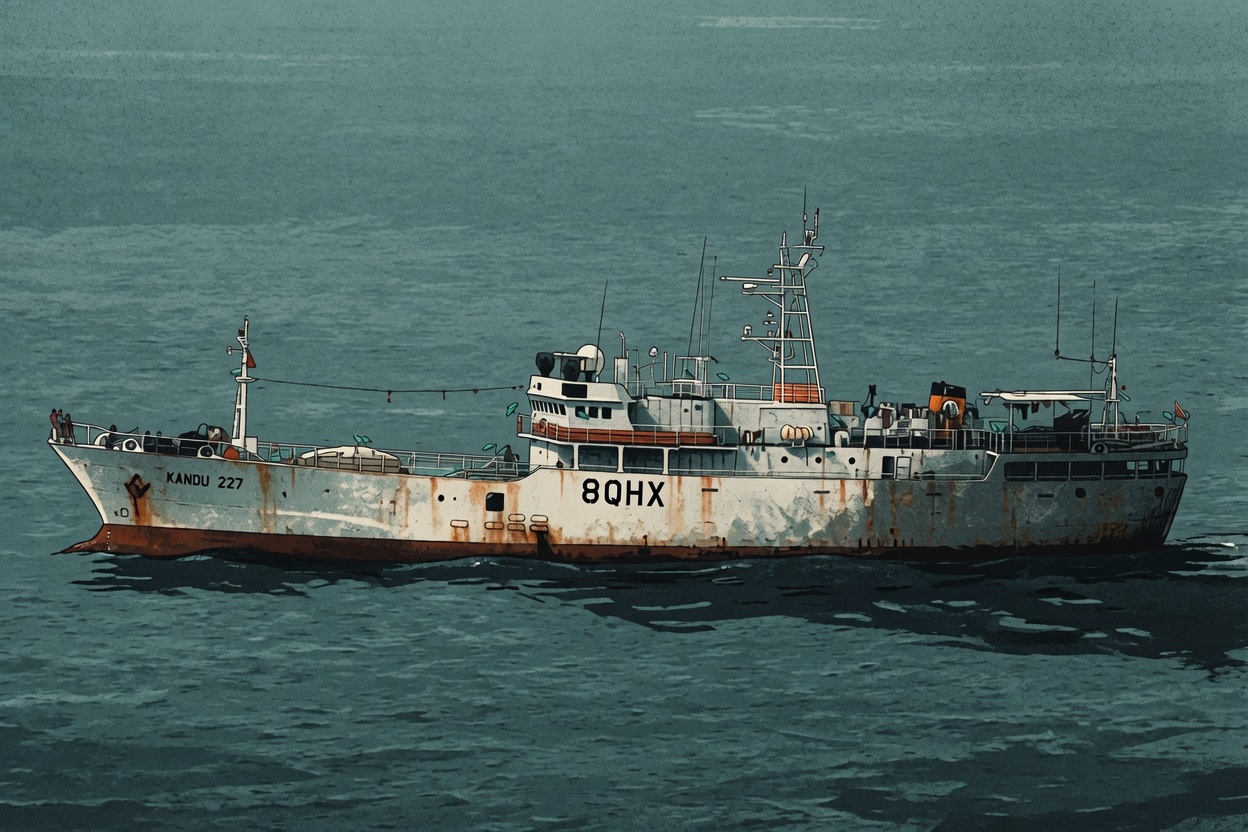
The Indonesian public erupted when the bodies of Indonesian crew on the Chinese ship Longxing 629 were buried at sea. What is rarely remembered is that the case actually broke from Korea: the ship transited and transferred crew in Busan, the story was uncovered by Korean television, and the advocacy was led by a legal-aid group in Seoul.
Oryong 306 & Dongwon 632
The testimony in this story. Distilled water for the crew, bottled water for the Koreans. 15–21 hour days. Bonuses that evaporate. Wi-Fi under lock.
Bowo and Joko sailed in this period.
Bottled water for the Korean crew, distilled water or air-conditioning runoff for the foreign crew. A bathroom for the officers, the open deck for the ratings. Work of 15 to 21 hours. Bonuses that hang on the captain’s judgment. Wi-Fi that can be cut at any moment.
The two Longxing crew who died, according to Ari Purboyo, who helped support the survivors, are believed to have developed beriberi after months of poor-quality food and water. Bottled water was kept for the Chinese crew, while the Indonesian crew drank distilled water that was salty and murky.
Four years later, Bowo describes almost the same division. The flag is different. The hierarchy is not.
“Bottled water only for the Chinese crew. The Indonesian crew drank distilled water, salty and murky.”
— survivor testimony, from reporting on the case“The bottled water brought from shore was only for the Koreans. We boiled water from the AC runoff.”
— Bowo, interview for this storyAll that differs is the flag — and how many cameras are pointed at it.
Taiwan, whose distant-water fleet was long accused of being a hub of forced labor, has at least set a specific minimum wage for foreign crew and changed part of its recruitment system. The changes have not erased the violations, but they show that public pressure can force a state to move.
Crew advocates acknowledge one difference on Korean ships. Compared with a number of cases in the Chinese fleet, base pay is generally still paid, though sometimes late or docked. But on working hours, isolation, segregated facilities, the captain’s control, and the risk of crew coming home in a coffin, the line between Korea, China, and Taiwan is far thinner.
The latter two have long been battered by the world’s scrutiny.
The first still looks tidy from shore.
Why Korea Escapes the Spotlight
If the conditions are known to the government and experienced by so many crew, why do their stories so rarely reach shore?
Mohamad Kafandi understands the answer from his own body.
The former Korean-ship crewman, who now leads the group Pejuang Suara Pelaut Indonesia (Fighters for the Voice of Indonesian Seafarers), was once beaten bloody by a drunken Korean crewmate. He reported it to the police, underwent a forensic exam, and pressed charges against the assailant — a step Indonesian crew rarely take.
The shipowner offered a settlement. The company reminded him that he could be sent home.
“If I didn’t dare to stand up myself, maybe there would be many other Kafandis who keep getting beaten. And they don’t dare to report it.”
— Mohamad Kafandi, Pejuang Suara Pelaut Indonesia
According to Kafandi, the impression that Korean ships are “perfectly fine” is born precisely from the silence of the victims.
“It really does happen,” he says of the violence aboard, “but many of the guys just don’t dare to speak up.”
To fight back can mean being sent home before the contract ends. Coming home early means bringing less money to a family that has been waiting for remittances — and perhaps carrying the debt of departure.
Distance reinforces that silence.
A Korean longliner can stay at sea for 12 to 19 months without touching port. Transhipment lets the holds be emptied and the ship resupplied without bringing the crew back to land.
No inspector comes aboard. No reporter. There is no phone signal. The only bridge to the outside is Wi-Fi, and access to it is in the captain’s hands.
EJF and APIL research documents the pattern. Bowo and Joko lived it themselves. Joko even recalls a small irony: he once met an independent observer while working on a Chinese ship. On the Korean ships, he says, there were none.
Aboard the ship there are also mechanisms that make protest costly. A grade of A, B, or C determines the bonus. One conflict with an officer can cut a year’s income. Crew who want to sail again also fear being blacklisted by the agent or the company.
Bowo closed his interview with two words: “Still have targets.”
A house. School for the children. Savings that are not yet enough.
After more than a year of drinking water from an air-conditioning pipe, he still needs the next ship. The company understands that need better than anyone.
Ari Purboyo has spent nearly ten years supporting Indonesian seafarers in Korea and arranging the repatriation of bodies. In his view, attention only truly comes when a case has reached the worst level.
“With Korea, what I’ve noticed, the highest level is a death. That’s what sends everyone into a panic.”
— Ari Purboyo, Jangkar
A system that moves only after someone dies is not a system of prevention.
It is a system that waits for a victim.
Meanwhile, tonight in the Pacific, those ships are still hauling their lines. Indonesian crew are still working on their decks. Some of the hulls appear as small dots on my monitor screen.
Others disappear.
The satellites keep recording what they can see.
The rest depends on who dares to come home and tell the story.